
Crawl space sump and drainage in Huntsville runs $1,500–$4,000 for a sealed sump with discharge and $2,500–$7,000 with perimeter collection. Where the lot has fall, gravity daylight discharge does the same work with no pump, no power, and nothing to fail.
When gravity is available, what a sealed sump requires in an encapsulated crawl, and why discharge location decides whether any of it works.
Gravity first, if the lot allows it
A pump is a mechanical device with a float switch, a power requirement, and a failure mode that tends to arrive during the exact storm you needed it for. A gravity daylight line has none of those. Water collected at the crawl perimeter runs downhill through a solid pipe and exits at a lower point on the property, and it works during a power outage because it does not know what power is.
Not every lot can do it. You need genuine fall between the collection point and a legal, practical discharge, and a fair number of properties on the valley floor simply do not have it. But it is the first thing we check, because when it is available it is both cheaper to run and more reliable than anything with a motor in it.
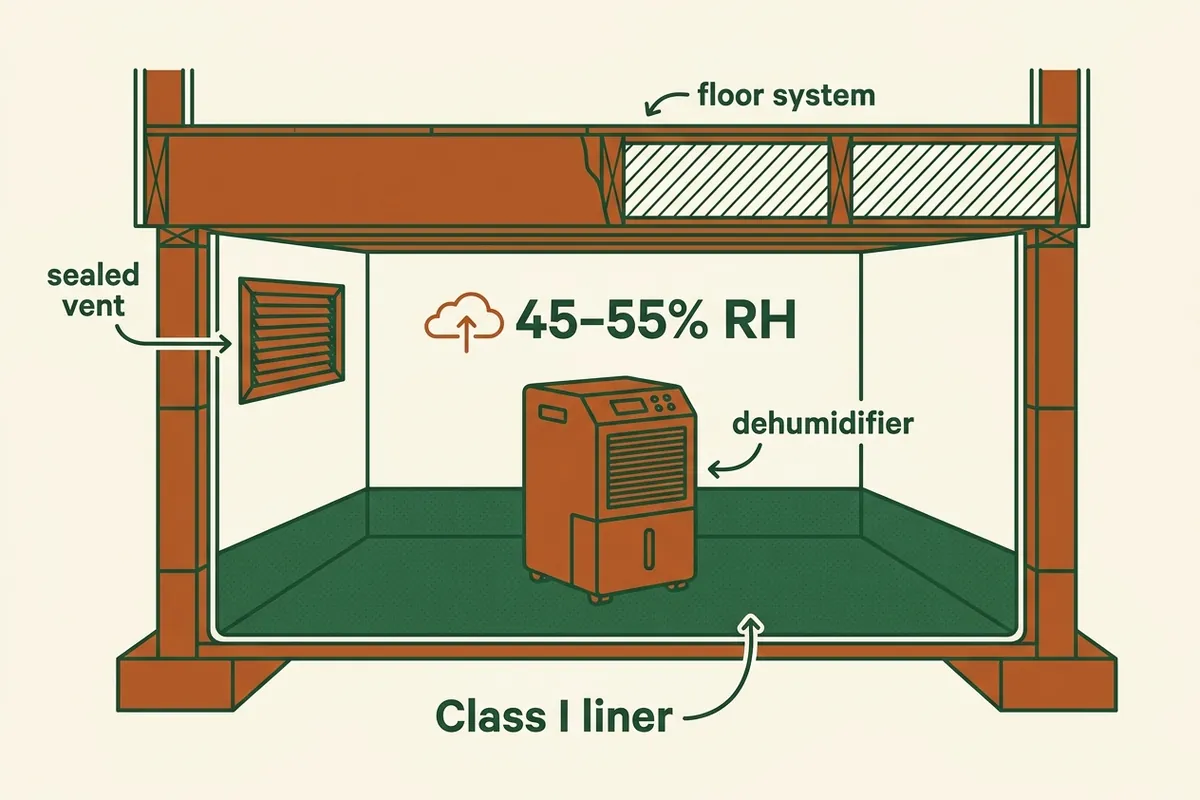
What a sealed sump requires
In an encapsulated crawl space, an open sump pit undermines the point of the work. It is standing water with an open surface, evaporating into a space you are paying to keep below 55% humidity, and it is an open path for soil gases as well.
- Gasketed, sealed lid with proper penetrations for discharge and any vent
- Liner tied into the pit rather than ending near it
- Check valve so the discharge line does not drain back into the pit and cycle the pump
- Discharge routed well away from the foundation, not to the nearest convenient point
- Backup power where an outage during a storm would flood the space
- An accessible service point so the pump can be checked without dismantling the liner
What the options cost
| Approach | Typical cost | Right when |
|---|---|---|
| Gravity daylight discharge | $1,500–$4,000 | The lot has fall to a legal, practical exit point |
| Sealed sump with discharge | $1,500–$4,000 | Water collects but there is no downhill route |
| Perimeter collection plus sump | $2,500–$7,000 | Water enters along a length of wall rather than at one point |
| Battery backup system | $800–$2,000 | Outages are common and the space floods without the pump |
| Exterior correction first | $150–$2,500 | Always — cheaper than anything on this list |
The mistake that makes a good system useless
Discharging too close to the house. Where the ground only absorbs about an inch an hour, water put down ten feet from the foundation does not disappear — it saturates the same soil the system was installed to relieve, works its way back, and the pump runs on its own output. We have seen systems cycling continuously in dry weather for exactly this reason.
Getting discharge right sometimes means a longer buried run than a homeowner expected to pay for, and it is the part of the quote least worth cutting. Prices for the whole scope sit in the cost guide.
Sump and drainage questions, straight answers
What does a crawl space sump and drainage system cost in Huntsville?
A sealed sump with discharge runs $1,500-$4,000, and $2,500-$7,000 with perimeter collection tied into it. Where the lot has enough fall, gravity daylight discharge runs $1,500-$4,000 and eliminates the pump entirely. Discharge distance is usually the variable that moves the number most.
Can I avoid a sump pump?
Often, and it is worth asking about. If the lot falls away far enough, collected water can be daylighted downhill by gravity - no power, no float switch, no maintenance, nothing to fail during the storm that matters. Flat lots on the valley floor generally cannot do this. The lot decides, not preference.
Does the sump need a sealed lid?
In a sealed crawl space, yes. An open sump pit is a continuous evaporation source and a direct path for soil gases into the space you just spent money conditioning. A sealed, gasketed lid with a proper discharge and vent penetration is standard on any encapsulated crawl and is a reasonable thing to require in writing.
Do I need a battery backup?
It depends on what the pump is protecting and how your power behaves. Tennessee Valley thunderstorms take power out and deliver the water in the same hour, which is the scenario a backup exists for. If the crawl holds mechanical equipment or the space floods without the pump, a backup is cheap insurance. If gravity discharge is possible, this question disappears.
Where should the discharge go?
Far enough from the house that the water does not simply return. Where clay only absorbs about an inch an hour, a discharge dropped a few feet from the foundation re-wets the ground the system is protecting, and the pump cycles on its own output. Discharge location is a design decision, not an afterthought.
Get a free Huntsville crawl space inspection
Tell us what you’re noticing — floors that give underfoot, a room that never gets comfortable, humidity the AC cannot pull down, standing water after a storm — and we’ll schedule an inspection that includes going under the house with a moisture meter and a hygrometer. We reply the same business day.